
How many restrooms does a farm operation need?
Field sanitation law is specific here. OSHA 1928.110 requires one toilet facility and one handwashing setup for every 20 hand-labor employees, and it has to sit within a quarter mile of where people are actually working, not back at the barn. That is different from general construction rules under OSHA portable toilet requirements, which use a sliding scale tied to crew size instead of walking distance. If your farm runs pickers across a spread-out field, you may need two or three standard porta potty rentals staged at different points rather than one unit at the entrance. Clifton itself does not have much active farmland left, but properties on the edges of town and operations we serve out toward Nutley, 4.2 miles south, and Lodi, 5.2 miles east, still run seasonal crews that fall under this rule. We help you figure out unit count with our how many porta potties do I need guide, then handle placement so walking distance stays inside the quarter mile mark, and you can always start the process through request a quote. For potable water, OSHA 1926.51(a)(1) requires an adequate supply at the jobsite, which we cover with tank refills on the same visit as toilet service.
What handwashing setup does field labor require?
Handwashing is not optional, and it is not satisfied by a bottle of sanitizer. 29 CFR 1910.141(d)(2) requires soap and towels or a hand-drying device at any handwashing station, sanitizer alone does not meet it. Our handwashing station rental units carry that setup as standard, and a portable sink rental works well next to a packing shed or equipment barn where crews wash up before breaks, and a hand sanitizer station rental can supplement it at field entrances. If your operation uses pesticides or herbicides, OSHA 1926.51(f)(1) applies specifically to washing after work with paints, coatings, herbicides or insecticides, so a sink station near the spray equipment storage matters more than one near the parking area, an issue we also flag for construction site services crews handling coatings. Read handwashing requirements for the full breakdown of what qualifies. For crews doing general labor without chemical exposure, the baseline standard from ANSI/PSAI Z4.3 sets one service visit a week as the normal interval for up to 10 users over a 40 hour week, which is the schedule we default to unless your crew size or hours push it higher.
Where should units go on a working farm?
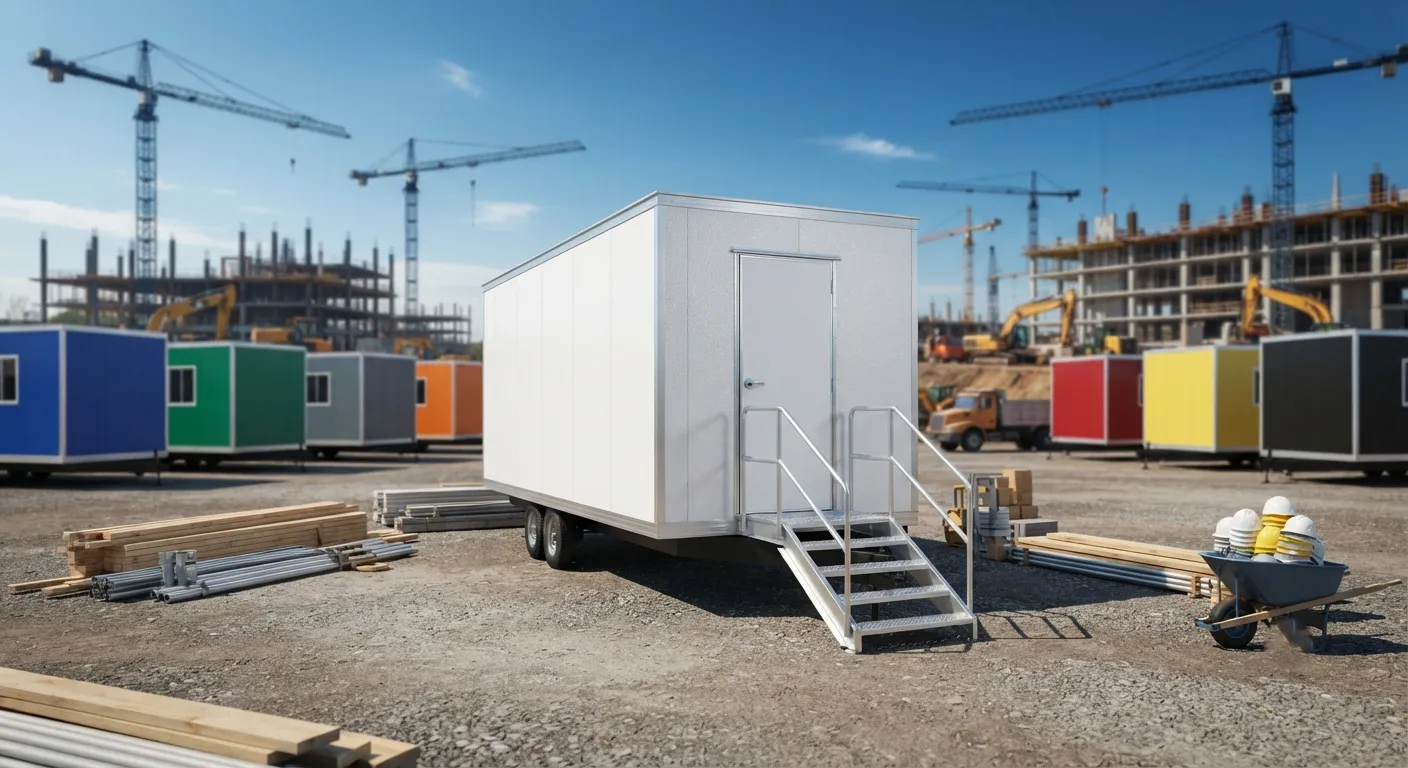
Placement on a farm is different from a job site with a poured foundation and a fence line. Ground has to hold the unit level, and ADA Standards section 302.1 calls for stable, firm, slip-resistant surfaces, which matters on soft field edges after rain. We service properties around Clifton and check ground conditions before drop-off, adjusting toward gravel pads or packed access roads when a field is too soft that week. A standard unit runs about 44 by 48 inches on the ground and 92 inches tall, so it fits on a farm truck turnout or beside a barn without crowding equipment traffic, similar to how we place a porta john rental on tighter residential lots. If workers include anyone using a mobility device, ADA Standards section 213.2 requires at least one accessible unit in any cluster, and our ADA accessible porta potty meets the 60 inch turning circle called for under ADA Standards section 304.3.1, with full requirements laid out in our ADA restroom requirements guide. Seasonal operations near Garfield, 3.7 miles northeast, and Montclair, 5.7 miles southwest, often add units at harvest time and drop back to one for the off season, and we handle that scaling under a monthly porta potty rental plan rather than rewriting the contract every few weeks, an approach that works just as well for home renovation porta potty jobs with shifting timelines. For farms with a packing operation producing wastewater or grease from a kitchen setup, a grease trap pumping visit may belong on the same schedule as your restroom service, and septic needs on the property are worth reviewing under septic pumping service.
Farms running events, like a fall festival or pick-your-own weekend, need a different setup than daily field labor, closer to what we cover under county fair restrooms or festival restroom rental. Rentals for that kind of one-day traffic price differently than a season-long field contract, so check porta potty rental cost before you budget an event weekend the same way you budget harvest season, and consider a deluxe flushable porta potty for guest-facing setups.
| duration | low | typical | high |
|---|---|---|---|
| day | 100 | 150 | 350 |
| week | 130 | 200 | 500 |
| month | 125 | 200 | 325 |
Does a farm need a permit for portable restrooms?
Placement rules can vary by property and zoning, and we have not confirmed a specific Clifton ordinance for farm sanitation units, so check with the city before finalizing placement near a road or shared driveway. See porta potty permit requirements for what to ask about.
Can one unit cover a 15-person picking crew?
Yes, one standard unit covers up to 20 workers under OSHA 1928.110, as long as it sits within a quarter mile walk of the field. If your crew spreads across multiple fields, you likely need more than one unit regardless of headcount.
How often does service happen during harvest season?
Weekly service is standard under ANSI/PSAI Z4.3 for up to 10 users over a 40 hour week. Larger crews or extended hours may need twice-weekly visits, which we set up based on your actual crew schedule.
Do farm restrooms need a water supply nearby?
OSHA 1926.51(a)(1) requires potable water at the jobsite, but it does not have to come from a well or hookup. We deliver water with the unit and refill it during scheduled service stops.
What if our farm is outside Clifton proper?
We still cover it. Distances like the 3.7 miles to Garfield or 5.2 miles to Lodi are typical for our delivery range, and we quote based on the actual drive, not a flat zone.
Next step
Get a delivery date
Tell us the address, the dates and the headcount. We size the order and confirm the route.